Workshop II · Fair Work for AI in Kenya
Fair Work AI Accountability
Lived experience, wage evidence, and a public exercise in what accountability demands when AI’s human shield works for two dollars an hour.
Thesis
Flip the script
Imagine a powerful AI company trained on millions of data points. It receives the headlines and the investment. Behind it: Kenyan workers reviewing the hardest content on the internet.
They keep AI polite and platforms usable. Without them, systems would be more violent, racist, and unsafe—yet they remain among the least protected people in the AI value chain.
Fair Work Kenya exists to say workers deserve dignity, protection, fair pay, and accountability—not charity.
Session highlights
What the room refused to soften
“$2 an hour in Africa—against $18 to $22 for Western counterparts doing the same kind of work.”
Sonia said the end client was not African; when workers asked about the gap, the company cited cost of living. She said it still did not make sense.
“Accountability means harm cannot be outsourced.”
If a company benefits from labour, it must remain responsible for the conditions of that labour.
“Leave promised twice a year; nearly eighteen months without going home.”
Billing pressure and client headcount logic were described as reasons workers stayed trapped abroad.
“There is no clear legal classification for this category of digital work.”
Without a baseline for wage, leave, and rights, accountability and compensation have nowhere to stand.
“The fight over digital labour in Africa is the fight for young Africans’ future of work.”
“Digital jobs” remain a political promise even as conditions stay precarious and poorly governed.
“What you cannot measure, you cannot manage.”
The workshop pressed for evidence, shared language, and harms that usually disappear because they are hard to quantify.
Quote & question
Sit with the point
A short walk through the session’s sharpest claims. Each card pairs a speaker’s statement with a follow-up question—use it to pause, reflect, and decide what accountability would require in practice.
1 / 9
Nomusa N.
Opening
“Accountability means harm cannot be outsourced. If a company benefits from labour, it must be responsible for the conditions of labour.”
Session exercise
Agree or disagree
Test your stance on five accountability claims from the workshop—outsourcing harm, ethical AI, “cheap labour” framing, legal baselines, and political leverage. Your answers stay on this device only; they are a reflection tool, not a score.
1 / 5
“Accountability means harm cannot be outsourced.”
If a company benefits from labour, it must remain responsible for the conditions of that labour.
Sonia Kgomo · From the session
What the wage gap meant
Sonia moderated Facebook content from Nairobi through a contractor. The end client was not an African company—yet African workers were paid a fraction of what colleagues “on the other side of the world” earned for the same kind of work. When they asked why, management pointed to cost of living. She said the gap still did not make sense.
“Our counterparts on the other side of the world were earning an average of between eighteen and twenty-two dollars an hour, while we in Africa were earning two dollars an hour. When we asked about this, they said it was because of the cost of living on the other side. But the gap was just too much. You can’t give me two dollars an hour and the other one twenty.”
- Daily shift
- 8–10 hours
- Gross at $2/hr
- $16 / day
- Tax cited
- ~35% PAYE
- Company line
- “Cost of living”
After tax, she said, you live hand to mouth—barely covering rent and food—while doing traumatic work for a global platform that can afford far more. Opening speakers named that pattern plainly: low wages are not a contractor surprise; they are part of the business model, and accountability cannot be outsourced with the labour.
Figures and phrasing reflect Sonia’s testimony in the recorded workshop, presented for public education.
From the room
The strongest moments in the session were not slogans—they were long, careful arguments. Each speaker’s passages are grouped below; where someone spoke at length, step through their cards with the arrows.
Nomusa N.
Opening · Alignment
Nomusa N.
Opening
“Imagine there’s a huge powerful AI company—or an AI model trained by millions of pieces of data. It gets all the credit. It gets all the headlines. It gets all the investments. But behind it, there are thousands of Kenyan workers sitting in a small room reviewing the hardest, darkest content on the internet. They are the human shield protecting the world from digital harm. Without you, AI would be violent, racist, unsafe, unfiltered, unregulated. You keep the digital world clean. You keep AI polite. You protect millions of users from harm. And yet, you are the least protected people in the entire AI value chain.”
That is why Fair Work Kenya exists, she argued: to flip the script—to insist that workers deserve dignity, protection, fair pay, and accountability. Not charity. Rights.
1/2·Opening
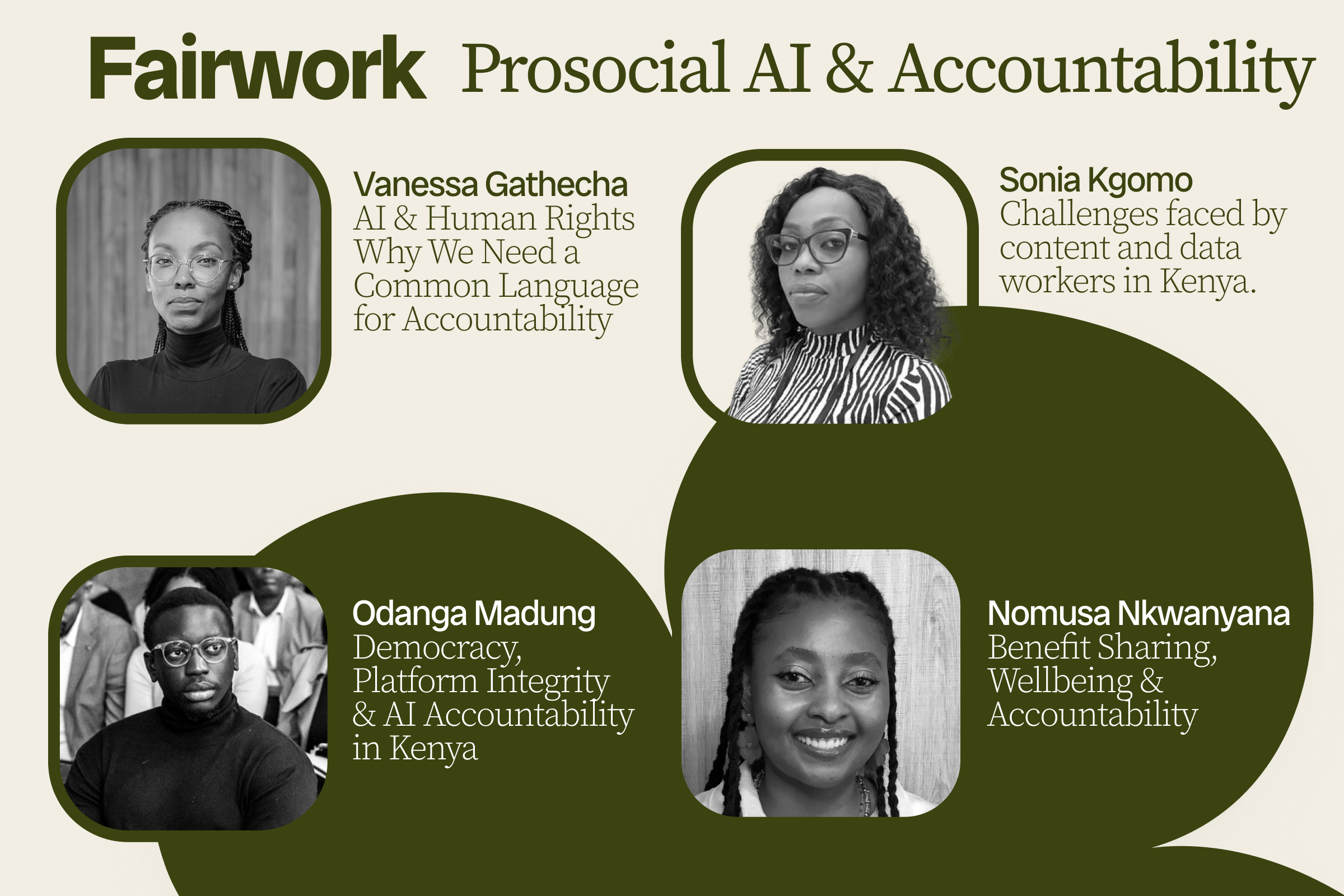
Sonia Kgomo
Lived experience · Wage gap
Sonia Kgomo
On the wage gap
“Our counterparts on the other side of the world were earning an average of between eighteen and twenty-two dollars an hour, while we in Africa were earning two dollars an hour. When we asked about this, they said it was because of the cost of living on the other side. But the gap was just too much. You can’t give me two dollars an hour and the other one twenty. It didn’t make sense at all.”
Sonia also described recruitment under an admin advert, late disclosure of Nairobi content moderation, NDAs used as silencing tools, leave denied for nearly eighteen months—then dismissal after organising, which led into African Tech Workers Rising.
Odanga Madung
Framing · Future of labour
Odanga Madung
On cheap labour framing
“We continue to position Kenya as this place where AI companies can get cheap labour. I think that framing is effectively a lie. When you say the word cheap labour, what you’re saying is that we can let you hire people, mess them up, destroy their lives, and get away with it. So long as we start our conversations from that perspective, I don’t think we’ll ever win.”
1/2·On cheap labour framing
Vanessa Gathecha
Closing questions
Vanessa Gathecha
Closing questions
“I am the kind of person who believes that what you can’t manage, you don’t measure. If we are going to change anything—whether it’s the narrative or leveraging power influences around us—then we need a lot more evidence. When accountability clashes with innovation narratives, who do we prioritise? What forms of harm are easiest to measure, and which disappear because they are hard to quantify? Who benefits when we fail to agree on a shared language—and who bears the consequences?”
She left the room with a demand for plural evidence, human-rights-centred design, and shared narratives that can bridge technologists, policymakers, civil society, and affected workers into 2026.
Session gallery
Speakers & quotes
Closing
AI cannot be fair while the people who label and train it are exploited. Fair work is not the soft edge of AI ethics—it is the condition of possibility.
Read the broader programme notes in the Fair Work Review, or continue with London Data Week: Accountability Across AI Labour.